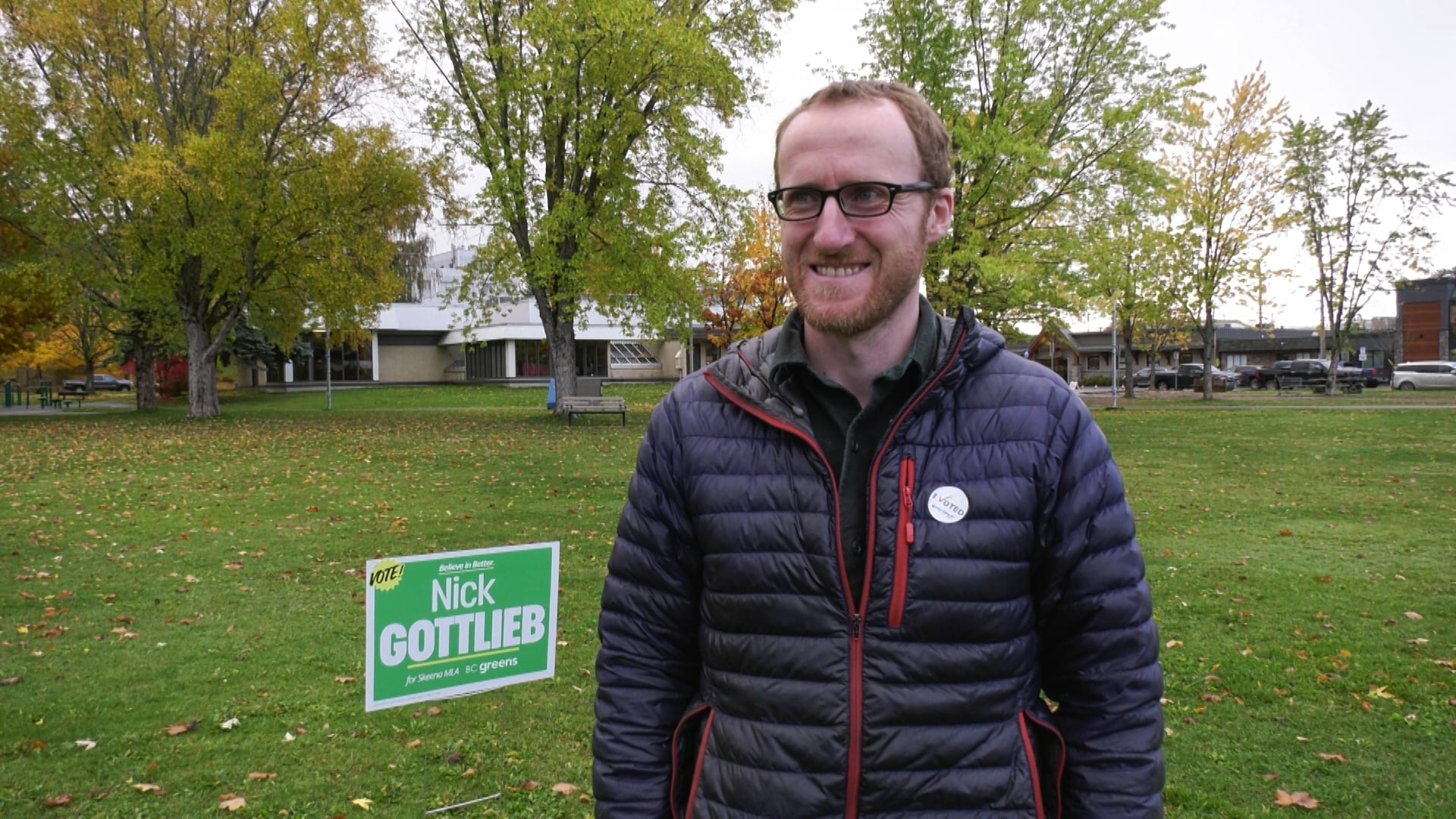
Big industry like LNG Canada, if they are taxed more, then they have less of an incentive to stay in the region if they don’t meet their profit margins. Why should they be taxed more?
This is one of the cheapest deals in the world that they can get. And they would still be extracting gas here. Companies would still be coming here to mine if they had to pay a bit more for those resources. And if we were getting a fair return, like some other jurisdictions are getting in the moment. What we’re getting is basically nothing in return for all of these industries except for the air pollution in Kitimat. All of the costs on our communities that are imposed by these industries, which many people in the municipal election were talking about, were paying a huge amount of money for these industries to come here, and we’re getting very little in return. And we’d like to change that.
Change it to what?
We’d like to change that by making them pay a fair share, which will support the infrastructure costs that they impose on our communities. The reason that we have all these raw commodity export industries in northwest B.C., people think it’s because there’s gas. It’s because there’s but there’s gas and minerals in a lot of different places in the world.
And our pitch is that supporting industries like this raw material, commodity export industries owned by multinational monopolies, with our industrial policy using tax dollars to support these industries. This is bad industrial policy. This is not an industrial policy that supports BC’s workers. It’s not an industrial policy that makes economy resilient to geopolitical volatility. We need instead to be using industrial policy to incentivize industries that use these resources here, that employ B.C. workers, that use B.C. supply chains to build the things that we need and build a better future.
What are the changes do you think you can make?
There are a few different angles that we’re looking at in terms of shifting industrial policy. One of the first ones is stopping subsidies to fossil fuel export industries, because we feel like this is a bad bet for British Columbia. And it also just involves handing out huge amounts of taxpayer money to companies like Shell, who certainly don’t need our money.
We’re also looking at using public procurement and sort of building regional investment planning authorities that can coordinate between public infrastructure provisions like municipalities, health authorities, all the rest of it. And build BC supply chains using procurement policies that sort of centralize investment planning through those groups. And we’re also looking at making it easier for small and medium B.C. based industries to move forward.
We’re seeing a bit of this in Canada, where direct public investment is being used to incentivize industry. And we think this is a great idea. We think that provincial and federal governments are currently using this to support the wrong industries, industries that don’t really support BC’s, workers, industries that are mostly foreign owned, industries that are mostly focused on raw commodity exports.
How is this different than the Northwest Resource Benefits alliance?
The point I was making there is about a making sure our supply chains so that, you know, in our region, there are some big public spenders. Those are municipalities are relatively small. The health authority is fairly big. There are other public institutions that spend a fair amount of money. And by using public procurement policies and a sort of coherent investment strategy and procurement strategy that sits on top of all of these public authorities and unifies them.
Under one strategy, we can make much more effective procurement policy and industrial strategy through those vehicles.
This sounds like increased bureaucracy.
We don’t really agree with that. We think there’s a currently a lot of these different groups are moving in opposite directions at the same time. And it’s very difficult to actually make coherent economic planning work. And we think that if we really want to use the public purse, which is already being used to subsidize foreign investors, if we want to use it to actually invest in BC, we need to coordinate that a little more effectively.
As of this conversation, the Conservatives are leading the polls. And the Green Party is not as big as the NDP. How do you plan on working on this when the NDP refuses to work with your party?
The first thing I’ll say is that simply by running this campaign, we’ve seen both conservatives and the NDP in this riding and provincially pick up a huge number of our proposals, not in the way that we would like them necessarily, but they’ve moved in that direction in order because they’re seeing how much what we’re seeing appeals to people.
I’ve seen people on the right side of the spectrum talking about how LNG is a bad deal for our region, which a month ago would have been unheard of. And so, by putting these ideas out here, by making it clear how popular they are among British Columbians, we’re already moving the political spectrum.
Beyond that, I would say from our perspective, the best outcome in this election is a minority government with the Greens holding the balance of power. And we think that’s the best outcome for British Columbians. We think a lot of British Columbians agree with us.
This gives us the opportunity to hold the line on standing up to big industries. I mean, the B.C. NDP is currently in negotiations with the gas industry about royalties and what we’ve been told by First Nations that are part of these negotiations is that we’re getting a bad deal. And unless the Greens are there to hold either of these two major parties accountable and their negotiations with industry, we’re going to continue getting a bad deal.