
Months after a B.C. Supreme Court justice dismissed a lawsuit from environmental and community groups, some of those representatives are now back in court fighting the substantial start designation once again.
The Skeena Watershed Conservation Coalition, the Kispiox Valley Community Centre Association, and local resident Kathy Larson argue that after nearly a decade of inactivity, the company’s last-minute work does not come close to constituting a substantial start on a project of this magnitude.
The legal challenge asks the court to find that the Environmental Assessment Office acted unreasonably in extending the project’s approval. At stake, they add, is the integrity of B.C.’s environmental assessment policies.
In conjunction with this , Representatives of Wilp Luutkudziiwus, a house (Wilp) of the Gitxsan Nation, are also there this week, also asking the Court to overturn the substantial start decision, which enables the pipeline project to proceed through the Wilp’s territory, alleging that the B.C. government failed to fulfill its constitutional duty to consult them on whether PRGT was substantially started before making the determination.
Shannon McPhail, co-executive director of the Skeena Watershed Watch Coalition, spoke to reporters outside the BC Supreme courts;
“It seems like this government is bending over backwards to seemingly break their own laws, to push this development forward. So we are here to stand up for British Columbians, for our watershed and our communities, to say, if you’re going to build something - then follow the law.”
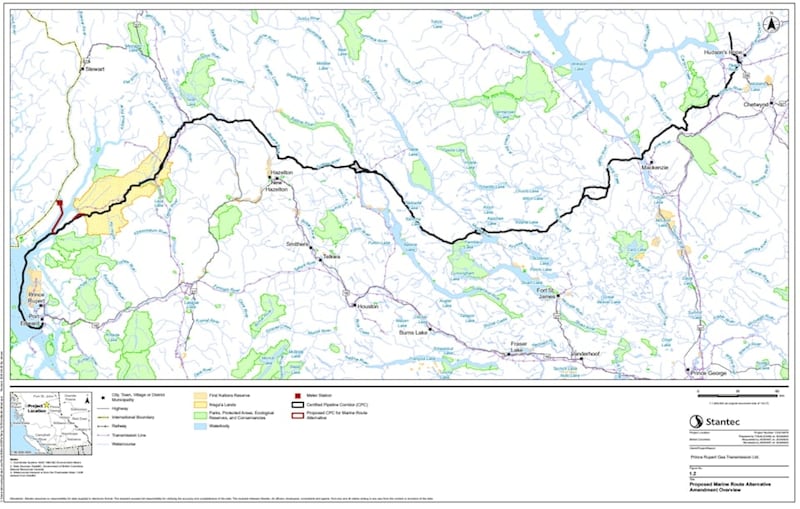
The 800-km Prince Rupert Gas Transmission pipeline (PRGT), co-owned by the Nisga’a nation and Western LNG, would carry gas from northeastern BC to the proposed Ksi Lisims LNG export facility.
The pipeline would cross more than 34 kilometres of Wilp Luutkudziiwus’ Madii Lii territory, including what they say are last remaining areas of untouched wilderness, as well as areas that Wilp members say they rely on to sustain their culture, identity and livelihood as Gitxsan people.
The group has previously set up the Madii Lii camp on that territory, established in 2014, when the original environmental assessment certificate was issued, which closed access to the territory to all LNG traffic and other unauthorized industrial activity.
That environmental certificate gave PRGT 5 years to substantially start the project, which was later extended by another 5 years.
By the November 2024 deadline, partial tree clearing on about 5% of the proposed pipeline’s length, along with some ancillary work, had been conducted.
Last June, the Province announced that the PRGT project was ‘substantially started,’ with BC’s environment minister and North Coast MLA Tamara Davidson saying at the time that she was confident in the Chief Executive Assessment Officer’s decision, and also that;
“The Environmental Assessment Office continues to assess requests for changes to the project route and where the pipeline ends, work which includes ongoing consultation with First Nations.”
However Hereditary Chief Luutkudziiwus (Charlie Wright) alleges lack of consultation, saying;
“The Province’s substantial start determination is silencing the significant and irreversible consequences that this decision will have on our territory. The Province’s decision will compromise our rights, title and the use of our lands—and we’re prepared to take this issue to the Supreme Court of Canada.”
If the project were to lose its substantial start determination, the PRGT project’s 11-year-old environmental certificate would expire and a new environmental assessment would be required. The project has yet to receive a Final Investment Decision.