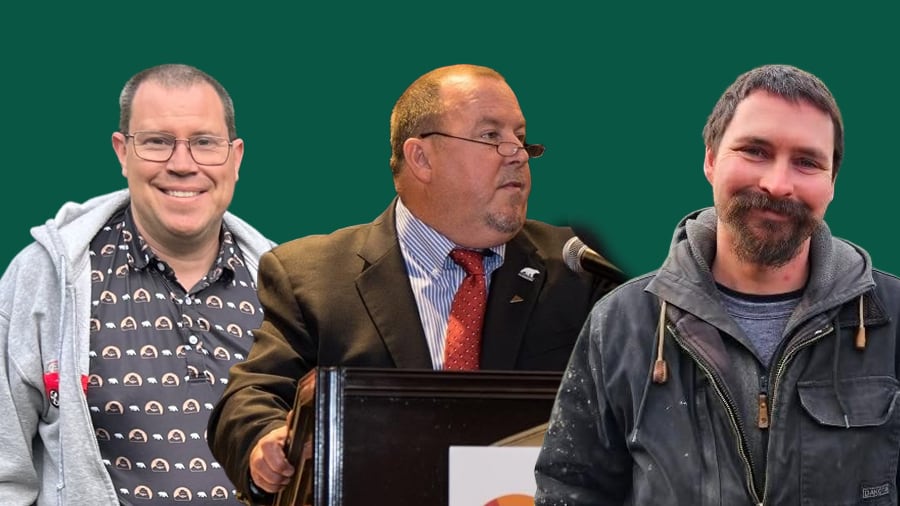
Over the past week, I interviewed the candidates who are running for the director position for Area C.
A key point of conversation that was addressed by the candidates were the proposed bylaws.
A copy of the proposed bylaws can be found here.
To address this topic fairly, I spoke with the current director, Bruce Bidgood about what was the take away from the open house on May 14.
He responded, “We messed up the Regional District. I don’t think that we communicated very well where we were coming from with this. First of all, I would say that I don’t think the people understood it wasn’t the Regional District sitting around a board saying, ‘Hey, I wonder how we can make it hard for people to raise chickens, I wonder if we can reduce the number of cows in Rosswood. It was nothing of that. We were told by the province that we would have bylaws in electoral areas. In B.C., regional governments are a product of the provincial government. They are our boss. We cannot say no”.
With the context established here are the candidates.
Candidate 1: Paul Harrison
Pitch: I think it’s a perception that a lot of us share is that the decisions are being made without a lot of input from from the residents. Now, as I like to be clear with this, because I do have some familiarity with the system.
If I get elected, it’s a pretty limited position because it’s a direct correlation to the number of voters and the number of that you have, you have in your area.
Area C, unfortunately, doesn’t have a lot of population density despite its size in relation to a couple of other other areas. So the other areas tend to get to kind of dictate, for lack of a better word, the regulations, bylaws and everything else. And really the, role as regional director is and this is kind of why do you bring something to the table is that I do have an understanding of of how all this works.
The most effective thing that I can do is to have regular meetings with the constituents, which honestly, I think has not been, critical about things. But I think that piece has been lacking, and it’s something that we really need to step up.
One of the other key issues is just the fact that there is the BC Hydro line coming through and all that’s kind of an elephant in the room on top of the proposed official community plan. It certainly it does go through a large section of area C, you know, as well as obviously area E.
And so that’s just another thing that people have been raising with me on different fronts. I’ve been talking to a few different people. And so, obviously there’s that. There’s a bunch of other issues as well. And that’s one of the great challenges of working with within area C.
It also makes my earlier point about how critical it is that we have regular meetings.
It just reinforces that because if we don’t have participation, if we don’t have meetings, if we don’t have the information getting out and getting the feedback from residents, then we’ll be continued to be treated like a single entity.
Candidate 2: Bruce Bidgood (Incumbent)
Pitch: This is a calling for me. It’s not a job. I had somebody quipped on Facebook the other day, as you can appreciate, you get all but oh yeah, career politician. This has never been a career for me. It has always been a calling, something that I take very seriously in a way that I can contribute back.
Why vote for me specifically? Well, first of all, I should let you know that during my day in my day job, I’m a professor at a university and I study organizational behavior and research and statistics. I am the dreaded teacher of statistics at university. The person that everybody fears, right. And I hopefully have tried to make that friendlier topic for many people.
But I’m a professor by day, so I think there’s a certain amount of technical skills there. And I do a lot of statistical and mathematical modeling. So I have a certain, aptitude in terms of numbers, reviewing budgets, doing projections, things of that nature. But in addition to that is my experience I have now. I was elected first in 2008, and I have now.
It’s almost, almost 20 years of experience working with local government, both at the city level, at the regional level, and I’ve been involved with the provincial level as well and even represented our area. So why vote for me? I have a lot of experience and I have a commitment to public service, which I hope will translate well to providing the kind of services that people need in area C.
In terms of the bylaws, what should have happened is we should have, even before anything was ever drafted, we should have called a public forum just at the point of time of saying, hey, we have to do this right.
How can we connect with you to get your input from ground one? I think the staff overstepped to a certain degree by trying to draft policies based upon other areas, like, I mean, but the board and I in particular should have put the brakes on. We don’t always know what the staff are doing on a day to day basis.
Candidate 3: Mathew Hidasi
Pitch: I feel that the majority of the electorate and I have significant issues with the proposed bylaw changes, and we should elect someone who will address those changes in a positive direction instead of a restrictive direction.
I stand to actually lose from the changes. I raise my own animals. I run a sawmill. I live a rural lifestyle. The restrictions that are coming in through the bylaws would directly hamper my ability to specifically feed my family with raising chickens and operating. I’m hoping to turn into a small business in the future, the sawmill.
I feel that we can address both the very rural areas, such as myself, while not restricting very rural areas like myself, and keeping developing areas that want to develop and become more urbanized or metro like.
I don’t feel that restricting thousands of people’s rights simply for 1 or 2 bad neighbors is reasonable. And I’m hoping that the majority of people can accept that a blanket rule that covers all of area C, just because one particular area is having issues, is not a reasonable approach.
The best way to bring in more money is to limit restrictions that you put on businesses, especially those baller sized businesses. We’re not talking major corporations like say, Walmart or the pipeline, but the intermediate localized businesses. The Webbers are a big name. They have a few different businesses that size business. If we eliminate restrictions inside Thornhill on particularly potentially zoning or actual restrictions that the bylaws are proposing, one of the restrictions the new bylaw was proposing was of small home business cannot make noise, a blanket rule like that and shuts down anything like sawmills, even carpentry, cabinetry, making stuff like that. So if we prevent those restrictions from coming in, we can allow growth to happen.